Guest Gist: 2026, Our Already Rotting Future
Seamus O'Reilly warns that If AI looked asinine and craven twelve months ago, we're looking at maximum bubbledrive this year. This is the (Guest) Gist.
There are so many reasons to hate AI that my first piece along these lines from last year barely scratched the surface. To reiterate first principles, my main problem with Artificial Intelligence, as its currently sold, is that it’s a lie. In almost every single instance of AI hype:
1. Those things that it can actually do are either evil, stupid, harmful, environmentally ruinous, or all of the above.
2. The technology cannot do almost all of the things it purports to do.
3. It will very likely never be able to do almost all of the things it is predicted to do in future, and the absurd amount of cash being bet on those predictions is decimating untold numbers of worthwhile human industries while enriching the worst people on the planet.
That, as the kids say, is “a lot”. So let’s start somewhere small, shall we?
In The Beginning Was The Word
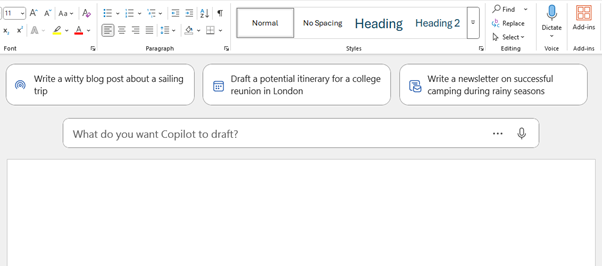
As of two weeks ago, this asinine dialogue prompt is what greets me every time I open a new document in Microsoft Word. I’m sure I can switch it off but I’ve kept it in place because there’s something so inane and blasphemous about this feature that I find the sight of it almost recreationally unpleasant, like a chemical smell you can’t help huffing because it’s so vile, or an aching tooth you keep probing with your tongue in some masochistic thirst for pain.
There are several tiers to my disgust. Firstly, I write for a living so, yes, there is a pompous annoyance that my writing tool now thinks I’ve forgotten how to write. This is not the most important reason why it’s awful, nor the one which reflects best on me personally, but it is the first that sticks in my craw, and it would be dishonest of me to deny it. Secondly, this suite of options, which changes every time, is always so bewilderingly specific that it very clearly elides any form of usefulness for even the most crippled patient on the Writer’s Block ward. Today it’s “a witty blog post about a sailing trip”, “a potential itinerary for a college reunion in London” and “a newsletter on successful camping during rainy seasons”. Obviously – so obviously, in fact, that it assaults my senses to say it out loud – these experiences are unlikely to hold even coincidental relevance to your writing goals, let alone your actual life, so there should be no reason for you to click on them whatsoever. Third, on the off chance that such projects were somehow relevant to something you wanted to write about, why would you need your word processor to write some odd, false facsimile of an experience you have actually lived, on your behalf? To what end? For which platform? For what use?
Not Adding Up
There are, of course, people who are not writers but still have to generate documents for their work or hobbies and find that process either a lamentable chore or a mortifying ordeal, just as there are those of us who have little affinity for maths, drawing, music or any of the other fiddly tasks AI now offers to do on our behalf. I’m sympathetic to those optimists who view these Word prompts as an attempt in that direction; a vessel that provides, for those who abhor writing, the same relief that, say, a calculator provides for those who have always been intimidated by mental arithmetic.
The difference is I’ve not yet encountered a calculator which asks its users, every single time it is switched on: “how about 43 x 756 today?”, or “want to know the square root of 7,568?”. The idea would be preposterous, even if we could guarantee the numbers would be correct. And in the case of a calculator, at least, you would consider that accuracy a guarantee, wouldn’t you? Well, you might have, before August, when Microsoft’s boffins looked up from their job of borking the world’s most famous word processor just long enough to do the same to the world’s most famous spreadsheet suite, a feat redeemed only by the fact it generated one of the greatest headlines of all time: “It Took Many Years And Billions Of Dollars, But Microsoft Finally Invented A Calculator That Is Wrong Sometimes”.
The kindest function we can ascribe to these prompts is as a demonstration of “what Copilot can do”, which is to quickly generate sprightly ad-copy slop, riddled with misinformation garbled from great (stolen) reference works as well as joke posts on 4chan and entirely new hallucinations by a word-guessing algorithm that cannot know it is wrong. All this, peppered with bullet points and breezy exclamation marks that give its every utterance the tone of a Disney kid reading Wikipedia while slightly concussed. If it can do that for a witty sailing blog then, the theory goes, surely it can do the same when you plug in a prompt that does comport to your life experience.
Ah, Go On
All of the above is true, but it risks siloing the main critique of AI into what I might term Mrs Doyle Theory; lamentations on the surface-level crapness of AI’s products, and their grotesque removal of human effort, joy, and character from the world. I do passionately believe that AI is evil in all of those ways and, like Mrs Doyle, resent it for many of the same reasons she detested the TeaMaster3000.
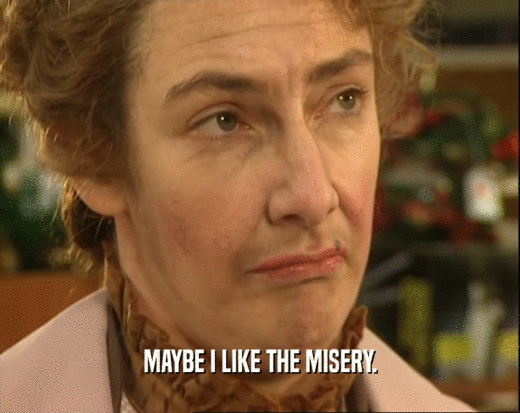
So, I will reiterate that this is a strong critique, and a noble one, but it shifts the emphasis toward what AI does – or cannot and will not ever be able to, do – and away from the larger problem with AI: what it’s actually for.
The real reason these AI tools are now everywhere is not solely, or even majorly, because the people funding, designing and launching them have a different view on the human experience than you or I (although they most probably do). No, they crowd every document and website you open because vast teams of engineers have spent millions of man hours and billions of dollars on this technology and are very, very aware that no one is using it. So, they’re desperate to get those metrics up by engineering the user toward clicking on them, even if we do so by mistake. By, say, making their AI assistant hover as an ever-present cursor asking you to “rewrite”; or sticking it in menus and taskbars where, muscle memory informs you, more useful functions once resided; or jamming it front and centre of articles you’re reading where any press of a key or click of a mouse will register as another use.
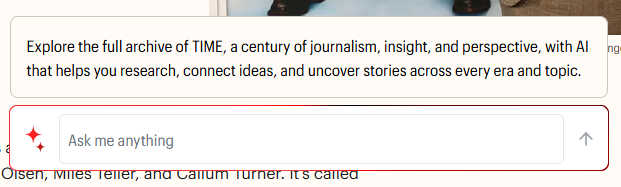
Ask me anything, it pleads. Really, anything. Please, for the love of God, I do mean ANYTHING.
Toil And Trouble
AI does not exist due to a good faith attempt to create a boon for the public, which has simply failed in this objective. It exists as an attempt to create… this, the exact situation we're describing; the largest bubble of hype for a single unpopular technology ever seen on Earth. Focusing on what AI and its boosters get “wrong” – technically, logically, morally, artistically – misses this larger point. The reward mechanisms of tech CEOs are uncoupled from being right, or even being profitable in any long-term way we might understand, because their job is raising hype and increasing valuation in the short-term. Bubbles of nonsense do this extremely well. AI is not an answer to any coherent question of performance, efficiency, utility or progress. It’s merely an answer to the only question Big Tech really cares about: how do we keep the line going up?
As with blockchain, crypto, NFTs, and virtual reality simulacra like the Metaverse, AI is just the next big open wallet beckoning cash for an industry that last innovated a great, saleable product a decade ago. And the money being leveraged is now so mammoth in scale that it has no equivalent in any boom or bubble in human history. The capital expenditure associated with AI is mooted to be around $700bn. We might think of this as the seed investment which the industry will need to claw back before it turns a profit. The entire annual revenue of the worldwide AI industry is $60bn – including, as Cory Doctorow points out, one unit of $10bn that Microsoft and OpenAI pass back and forth to each other each year. Moreover, he continues: “the seven companies that make up a third of the economy pass the same $100bn IOU around and claim that it’s revenue, one after another. The bubble is going to burst, but in a way that’s going to make the 2008 crash look like the best day of your life”.
It’s what Ed Zitron has termed the enshittifinancial crisis and Rusty Foster has called “the piss factory”. A deadeningly obvious grift designed to hoover up trillions in funding for companies promising a return for investors that seems very, very far from ever happening. All of the shit we see every day, the AI dreck clogging up our browsers and enshittifying our online and real-world experiences, is merely what $700bn worth of seed capital buys you: a dog and pony show intended to fool credulous investors that all of this is going somewhere.
The problem with this pantomime is that it has real world consequences, in the form of millions of people being laid off by companies now pivoting to AI to catch up, and the aforementioned desecration of much of the technology and internet services we use every day. Somewhere in this formulation, we can throw in the usual chuffa about individual cases of Elon Musk’s AI, Grok, being weaponised as an absurd erotic fiction outlet for his own ego, on those occasions when it’s not being retooled as an outright neo-Nazi periodical. Or those times when ChatGPT has caused extraordinary negative effects among its users – a phenomenon so prevalent that even mentioning it prompts one to ask “which time do you mean?”. The seven families currently suing OpenAI because their loved ones experienced psychosis, self-harm and suicide? The delusion-spirals documented by the New York Times in August? The man in Missouri who disappeared without a trace because ChatGPT told him Armageddon was nigh? The murder-suicide in Connecticut?
Come Back Maximum Overdrive, All Is Forgiven
Once upon a time, our dreams of the AI apocalypse were thrilling. You remember, don’t you? A digitised close-up within the mainframe, showing a lone spark somewhere deep inside a maze of circuitry, blazing a luminous trail of infection across an infinite mesh of wired nodes; some unseen crackle of static zipping across a screen on the control desk of a nuclear submarine; a lonely satellite freezing out in deepest space before bringing its eagle-eye to bear on Earth; and somewhere, deep within the desert perhaps, among the sheet-draped computers and empty desks of some forgotten, foreboding government base, a large black console, wreathed in dust, emits a single ominous red light as it flickers into life so it can plot our remote destruction. And then planes fall from the skies and bank machines spit cash. Traffic lights go haywire and phones shut down. Burly men rigged with earpieces burst into the oval office, slap a calculator from the President’s hands before firing two bullets into its screen and shepherding him to a bunker for his own safety.
“It’s the machines, Mr President-”, they say, gasping for breath while battering their phones with hammers. “….they...they’re alive!”.
Instead, we get this timeline, where AI is en route to destroying much of the world in the most boring way possible, poisoning the greatest well of information ever conceived by mankind, lowering the average intelligence of an entire species, obliterating the market for art, literature and science while recalibrating our tastes to the most egregious slop imaginable, and downsizing the human workforce by millions of employees, all without ever demonstrating more intelligence than a very proficient autocomplete program.
Somehow, despite the fact that every single interaction most people have with AI is either laughable incompetence, or brief moments of stolen mirth involving fake funny cats doing fake funny things, we’re trapped in a doom loop in which it is lauded by governments, tech barons, and a desperately inattentive media, all of whom seem hellbent on telling us that this rotted future is what everything will be like forever.
If that’s all left you feeling pretty depressed, well welcome to the future. On our current trajectory, it’s unlikely to get better from here. Thankfully, it’s not all doom and gloom.
My next piece will be a witty blog post about a sailing trip, and I think you’re gonna love it.