Mini-Gist: Power’s Walled City
Yesterday’s plan to control internet has already dwindled down to a pilot, with no MyGovID integration. This is the Gist.


Ireland is a polity where you can go and visit a Minister in a constituency office on a weekend to ask for help filling in a form.
The distance to/from officeholders is effectively zero.
But the distance for most people from power can be (invisible to them) huge.
Patrick O’Donovan went out on the national airwaves with a half-baked, bad set of ideas about linking access to online spaces to our PPS numbers. Crucially, he also proposed also embedding the age verification duties (and risk, and cost) on the Phone Monopoly Controllers, Apple and Google.
If he had these ideas himself, it would be a Christmas miracle.
But in fact, they are Zuckerberg’s Meta’s lobbying aim across the world.
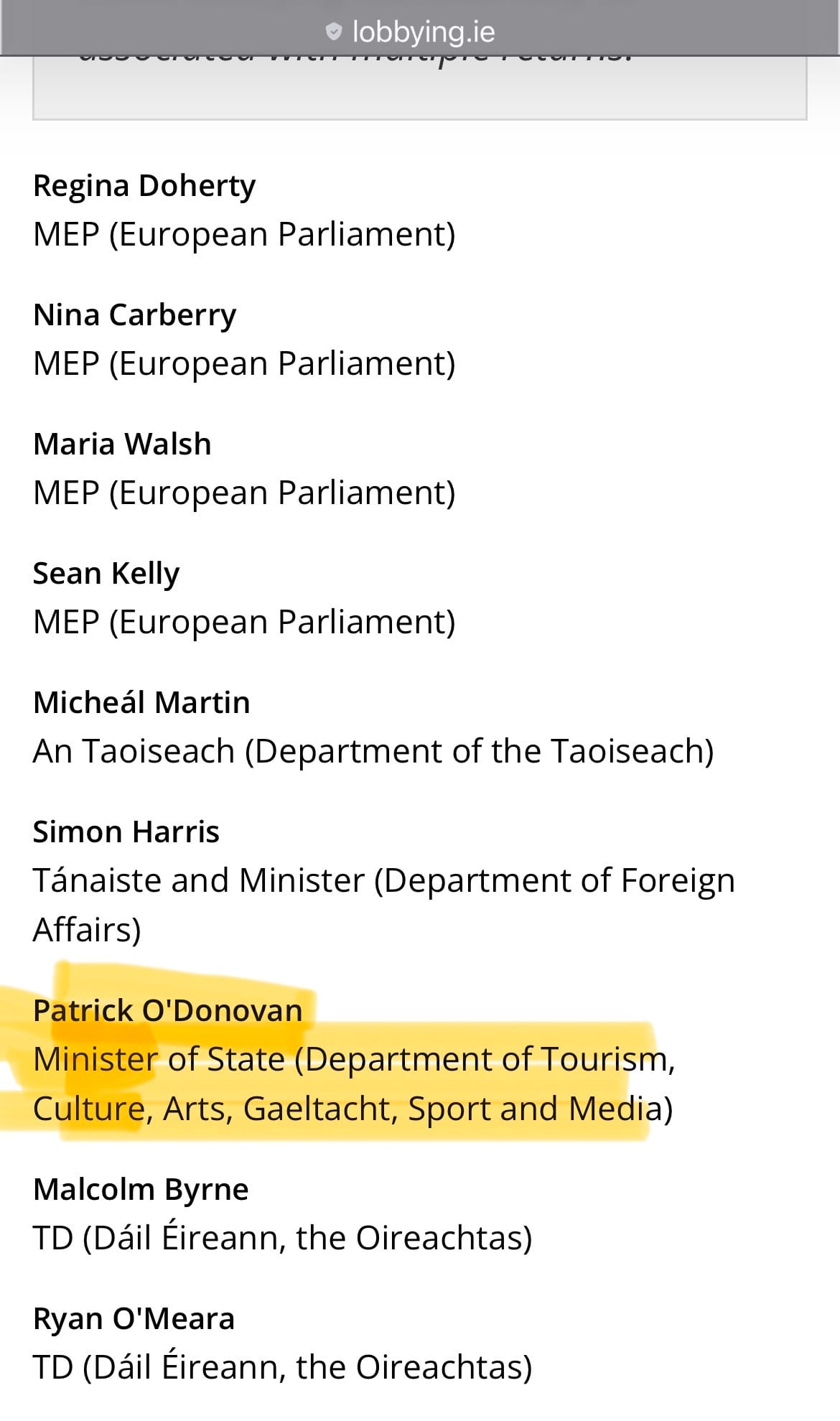
And, given the fact that the register of lobbyists features a record of the same Minister being lobbied by Facebook on this exact plan a few weeks ago, I think we may safely let the Magi know they will be spared a trek to Limerick this year.
Now, the consequences of the Minister’s ideas would be pretty terrible. Elon Musk would be plugged into the state database built on our PPS numbers, for example.
But what it demonstrates is that the power to make a policy and then see a government adopt it largely sits outside of political parties.
One of the evident failures of the FF and FG party candidates in the Presidential election was their inability to articulate what either party was for.
These are hollow vessels, whose policies are largely set by outside forces.
An organised external lobby can simply slot their preferred policy in.
But this power isn’t available to just anyone. The two civil war parties recognise that certain interests are inside the walls and some are outside.
Being located in the liberties, people and groups outside the FF-FG walled cities can say heterodox things like “I think children are people not property, so their human rights of expression, privacy and data protection matter too.”
Meanwhile established lobby groups, long inside the walls, can say “Ireland should use a chunk of its EU political capital to get a nitrates derogation so dairy farmers don’t have to change how they work right now.”
Most Irish people are not dairy farmers, and would prefer clean rivers. And, if you were thinking about governing long term, you would want to use your derogation to prepare dairy farming to stop polluting everyone’s water. Instead this is just the latest in a line of extensions to the derogation without any changes even started.
When Patrick O’Donovan unveiled his underbaked pie of an Internet policy giving Meta what it wanted, it was because they are inside the walls, just as powerful (but less visible) than the farm lobby.
This is the malaise in Ireland’s democracy.
A Democracy where politicians are in constant office, but do not respond to citizens’ wishes (or even just their own voters’ interests) but just advance the policies that suit monied lobbies is a disaffection machine.
Because people lose hope.
There are ways that people outside those established walls can force change.
They can, for example, insist on the Government following the law.
And the Govt are trying to stop that from happening by restricting judicial review.
Or they can try to organise their own counter-campaign, to raise the possibility of one of those policies that lobbyists made earlier costing FF or FG actual votes
But the Government is acting now to restrict, impede and install state controls over the access to the online spaces which reduce friction in that kind of organising.
The insulation of living inside walled cities is that those inside them tend to only hear people like them
This, as we know, is amplified when their main exposure to “what people are saying” is a social media site owned by an openly far-right billionaire whose algorithm keeps showing them Nazis.
The background to all of this, in Ireland, is that this power structure feels like it is nearing an end. The combined vote for FF and FG at the last election fell again to about 43%.
They can’t address the crises- infrastructural, administrative and cultural- blocking housing. And they know that they are reaching the limit of society’s tolerance of being told to live into middle age in their parent’s box rooms.
In the gap between the financial crash and the eventual much-anticipated defenestration of Cowen’s FF from office Ministers started signing 10-year contracts with service providers.
Those inside the walls wanted to know they would stay, no matter what.
Expect to start seeing mentions of something similar from the end of next year onwards.
Because when empty parties look like they will lose the patronage powers of office, they find that the walls keeping that power away from the electorate can fall very quickly.
And be aware that voters organising themselves online to object to the established policies of the civil war parties has been one of the main drivers for today’s efforts to introduce state controls on access to online spaces.
If we’re going to escape these social immobilities on housing, on welcoming people, on climate and environment- on a plethora of issues you could reel off like a 1950s catechising Bishop- we will have to speak to each other directly.
We will answer half-baked, unworkable lobbyist plans being pushed from within the cracked walls with a clear “No”.