The Gist: Sunshine and Lollipops
A report released this week was full of good news about people and bad news about political and media institutions. This is the Gist.


Let's start at the very top of this story. We should begin with the best possible piece of good news. When you go out of your house and look at the people you encounter all around Ireland, contrary to what you may have been told or led to believe, the vast majority of them are sounders.
- 75% agreed "Transgender people should have the freedom to be themselves and live their lives", up from 70% in 2024.
- 80% agreed "Black, Asian and minority ethnic people face bigger barriers to success than white people", up from 75% in 2024.
- 77% believe people seeking international protection should be supported to become part of the communities they live in.
- 69% said "the best way to address the housing crisis is to fund public housing, compared to 31% who believed restricting immigration is the solution.
- 70% agreed that misogyny remains a serious issue in Irish society.
These happy facts were brought to light this week in Mind the Gap, a research-driven report from the Hope & Courage Collective which has shown a statistically significant gulf has opened up between the direction of travel of public attitudes (good and getting better) and regressive political discourse (bad and getting worse).
Let's look at the numbers first and then we can see if we can explain why our political and media class is reflecting an increasingly funhouse mirror version of the Irish electorate's attitudes. (I don't know why, but I feel I should say that H&CC is a client of mine).
Here comes the science bit
H&CC commissioned a survey in 2024 and again in 2025, with the same questions. So we don't just get a snapshot, but also the direction of travel for public opinion between the two years. The sample size was 3,000. (For comparison, the longstanding and respected Ipsos MRBI poll is of about 1,000). So this is a statistically significant sample size. The surveys were conducted by Dynata and then the data was independently weighted by Ireland Thinks, to control for age, gender, ethnicity and voting behaviour so that the results would be representative of the general public.
Basically, when it comes to polling, this is the good stuff.
Racism's Travelling Salesmen
The report is broken into three chapters, reflecting the activities of its commissioning organisation. The first, Far Right in Focus, describes the specific actions and tactics of the far right in Ireland since 2024. For those of you, like me, for whom time is becoming less a series of events on a line and more like an impressionistic smear of things that may have happened in some order or other, I offer by way of context the fact that the Dublin riot happened in November 2023.
That chapter details the Extremely Online nature of far right organising. One of their main tactics is opening facebook groups on local issues ("Concered Porlock Parents Against Poets") and then continuing them as a vector for various poisons long after their proximate cause has gone away. ("If Xanadu is so Stately, why doesn't the Kubla Khan go back there, huh?") It also showed just how hard full-time grifters have to work to try to keep the fake appearance of local animus up, leading to some Richard-Scarry level questions of What Do These People Do All Day?
"A recurring feature of often short-lived local mobilisation groups was the involvement of far-right organisers from outside the area taking on leading roles. For example in Athlone, Bundoran, Castleblaney, Carrickmacross, Letterkenny, Oldcastle and Roscommon, the same person travelled to distribute flags and livestream, while helping organise and promote the same type of events in Kilcock."
The second chapter puts some numbers and facts around the crappy online experiences that most of us have experienced for ourselves. Basically, if your social media platform of choice is built on showing you things according to an algorithm, then that algorithm is being used (or, in some cases, is actively intended) to deliver you a completely false image of Irish public opinion.
Firstly, let's deal with where that 'Irish' political commentary is coming from:
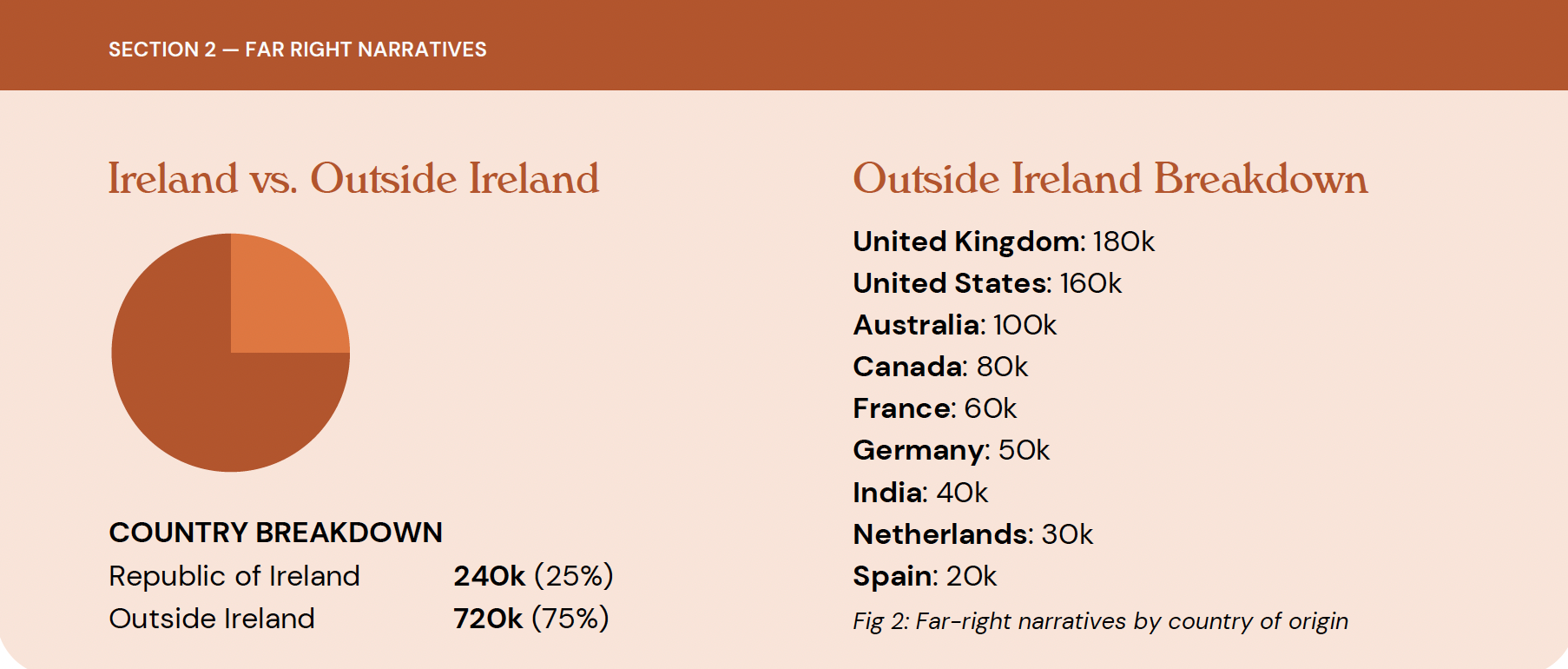
Comments relating to Ireland are mostly being run as part of larger astroturfing (and in some cases, astro-terfing) campaigns from other, bigger, English-speaking jurisdictions. Three quarters of the far-right discussion about or referring to Ireland is being posted from abroad.
However, for our purposes, the most interesting section is the sub-chapter headed "Narrative Manipulation and Political Mainstreaming". Because, under this wordy title, is a story that explains much of the behaviour of our political system (and the media courtiers who follow its lead) for the last two and a half years.
Loser talk
Our political and media class are sitting all day every day on X (formerly called Twitter) and they are having their brains cooked in an algorithm deliberately designed to promote fringe right wing opinion.
This is not organic chatter from voters but deliberate farmed and framed material, three quarters of it originating from outside the country, which is aimed at amplifying the appearance of far-right narratives in connection with electoral events. In other words, this is foreign interference in our elections.
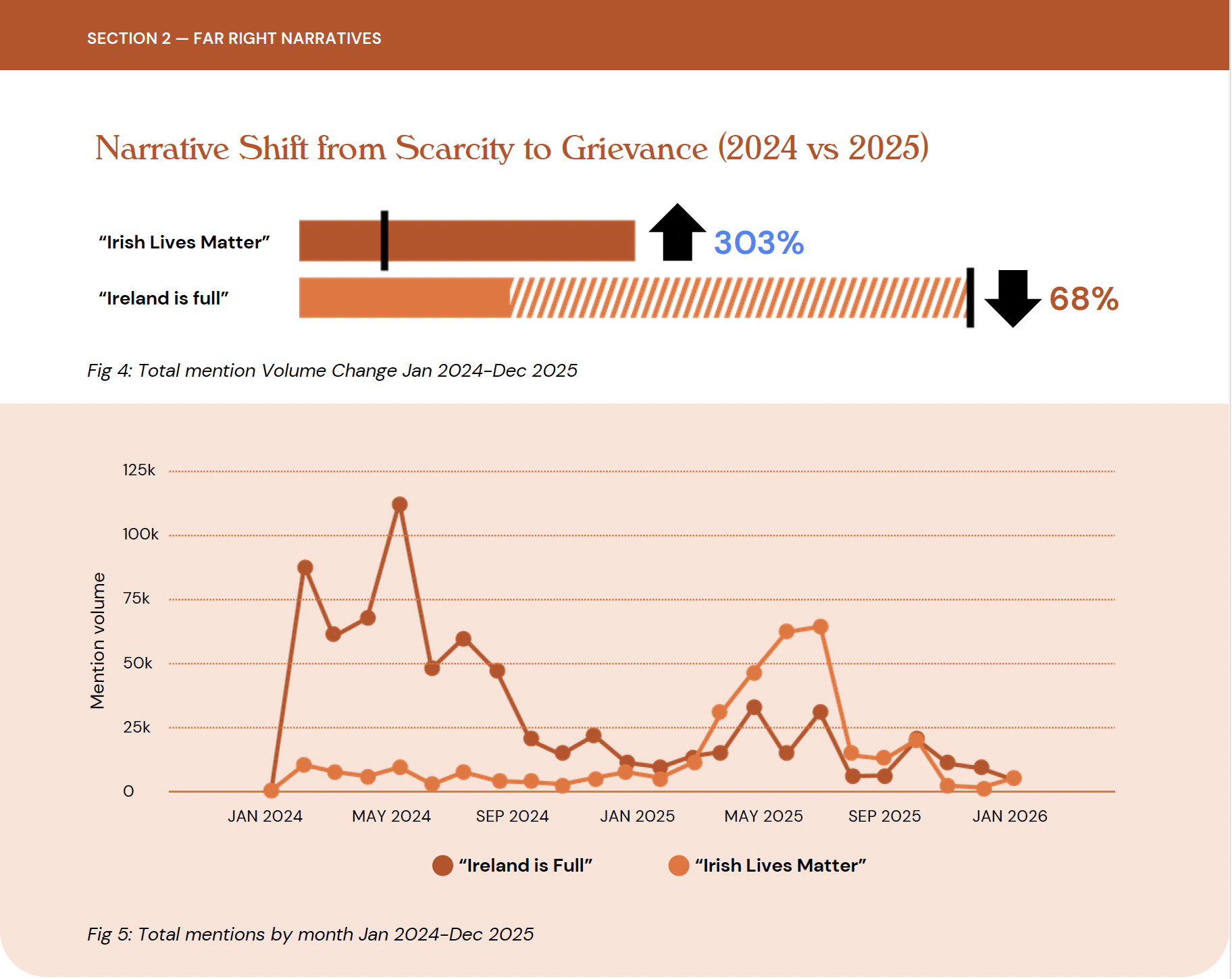
Take a look at this graph showing the contrasting narrative frames adopted in 2024 and 2025 by this battery of bots. The 2024 peak comes just before the Local Elections in June and was based around a story of capacity.
“Ireland is Full” operates through a container metaphor, framing the nation as a finite space under pressure, with migration presented as a strain on housing and services. The emphasis is on scarcity and capacity, allowing actors to position their arguments as pragmatic concerns about limits.
Now this has two effects. The first effect aimed for was the election of lots and lots of far right councillors. This absolutely did not happen because these people are such born losers and transparent weirdos that the national electorate just was having none of it. We'll discuss the second effect below.
After that there's another effort in 2025, aimed at supporting the choice of a far right presidential candidate, primarily through the county council nomination process. Here, they try a new frame, the first one having failed. This time they go for what the report refers to as an "identity and victimhood" frame.
[The new language] including terms such as “IPAS,” “illegal,” “traitors,” and “remigration,” signals a sharper grievance and victim based narrative rooted in perceived betrayal and loss. This sharpening coincides with the failure of far-right electoral strategies and a decline in large-scale mass mobilisation.
Basically, as you will recall from the run up to the Presidential election, the far right ran a campaign of whinging that they weren't being treated fairly, because they couldn't get their candidates onto the ballot, due to democracy or some such.
But I think one of the things that this account from the report misses is just how electorally focussed this switch of narrative is. One of the reoccurring references from the bot farms in that 2025 grievance-run was to Conor McGregor. McGregor, whose MMA background and fondness for squashing his size M body into a size S suit makes him a sort of avatar for the phrase 'battered sausage', had lost a November 2024 trial where a High Court jury found he had raped Ms. Nikita Hand. Nonetheless, he had appealed that decision and then started a shambolic attempt to seek a nomination for the Presidential campaign on an avowedly far-right anti-immigrant platform. The only available narrative, given the court decision, was a grievance-based one presenting him as the victim of injustice.
You can follow this timeline on the chart up above. The bots rolled in behind him, ramping up this grievance narrative between February and June 2025. Then, in July, the Court of Appeal rejected his attempt to overturn the High Court decision and the bots' interest in Ireland crashes down as their man becomes unviable.
Nobody wants this but it's all I'm hearing about
Time to return to that second effect I mentioned above. Sure, the losers and degenerates of the far-right can't get their unfiltered candidates elected in any meaningful ways because of their abject repulsiveness. But having this foreign interference programme aimed at our political and media classes can still have an impact, as they react to what they falsely perceive as organic public concerns.
The report reflects this;
This “bleed” of far-right framing into mainstream politics has been reflected not only in political messaging but also in policy debates and government actions concerning migration management and asylum systems.
Now take a look at this interview with Simon Harris on RTE radio 1 this week and pick out the strands of those scarcity and grievance narratives. You don't get more mainstream than this.
Recognising the Problem is part of the solution
Take a look at the report's analysis of how the cycle of influence builds on the platform amplification system. It can be applied to explain otherwise surprising or unexpected events. For example, apply this to the recent Lorrymen protest and how that was both created online through facebook groups, presented to the public by far-right actors introduced by the media as representatives of the protestors, and then responded to by the political system.
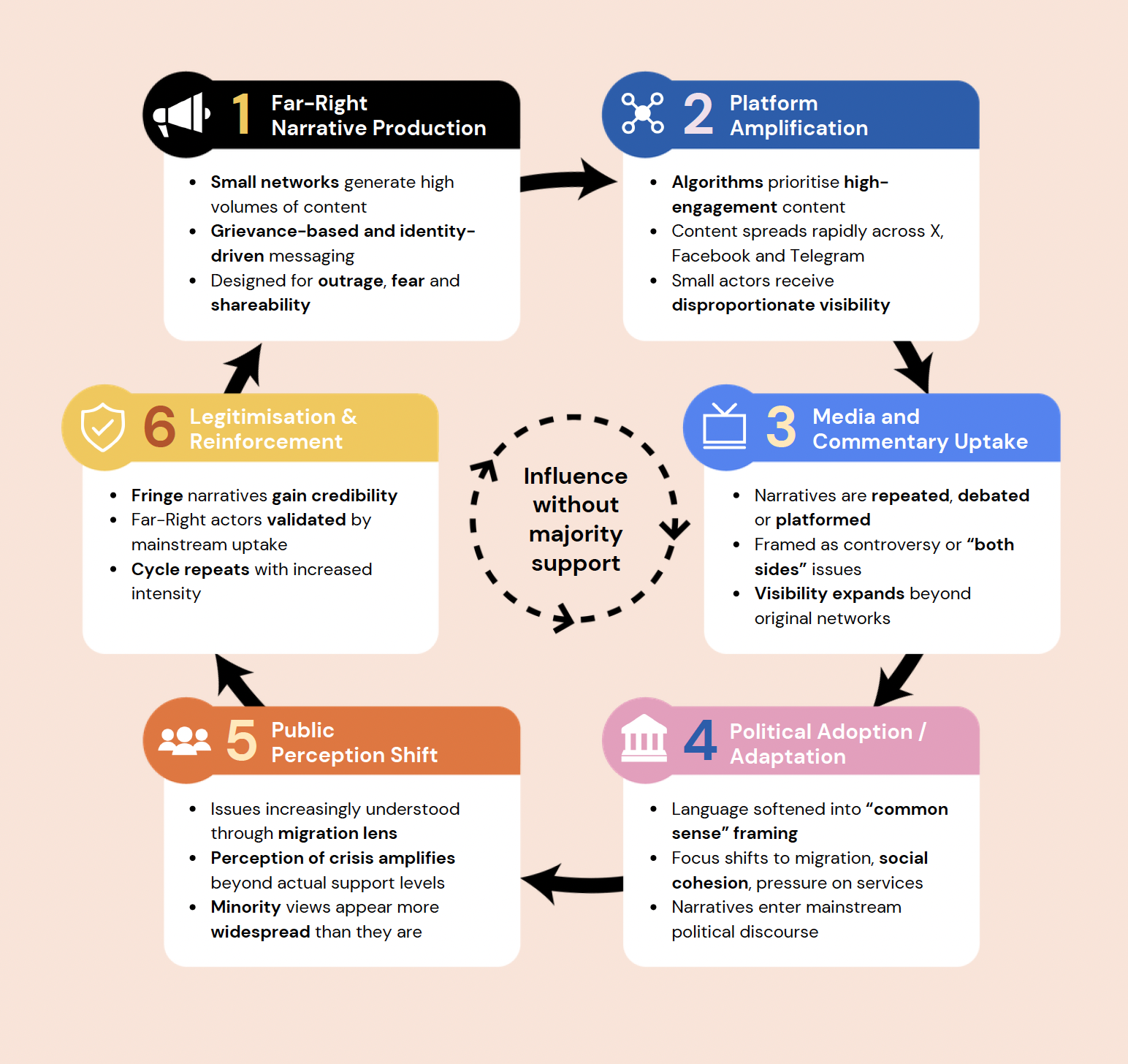
This report tells us two things. The first, and most important, is that most people are decent and that the more they are exposed to discussions of controversial things, the more likely they are to decide to support the decent position.
The other thing it tells us is that we have political and media institutions which are completely incapable of recognising when they are being targeted by foreign interference campaigns.
Their choice to sit inside the X/Facebook algorithmic funhouse mirror version of the country and to make policy decisions based on the distorted images pumped into it from abroad may be one of the most consequential failures of our political system.
So far, voters have acted as the bulwark against the worst consequences of that decision. But with Independent Ireland now emerging as a voice for this hybrid of far right messaging and mainstream deniability it will be up to us, in between elections, to have to keep insisting on reality over the right's fever dreams.