The Gist: The Abuse Factory
X, the child abuse imagery app, revealed our state has no red lines. This is the Gist.


In Dublin, on Fenian Street, there's a factory that makes child sex abuse material. You can pay it money, as a subscription, and that's one of the services it offers. This doesn't happen by mistake or because you've tricked or hacked the system. That's just part of the features its owner has advertised as one of the benefits of being a customer.
It's owned by a foreign industrialist, as they used to be called. But the European offices of this factory are an Irish company called X Internet Unlimited Company. Back before its current ownership, it had a fair number of Irish employees, but they've mostly been let go. It isn't a commercial behemoth, but it is unquestionably regulated by Irish law.
Now, the factory also does the equivalent of printing information leaflets for the Irish Government. And Irish media use it to tell each other, and the Government, that they have published their work on their websites. The media also use it to boil their brains in algorithmic far-right cess, but they're not as keen on talking about that.
Schools use it, because it used to be a handy way of communicating with parents about what their children did while they were in school. They'd post wholesome pictures of children from 5 up, doing sweet and fun things at events like Sports Days or Charity collections.
All of those images of Irish children from school accounts uploaded to this factory are now available, as a result of this new feature, for anyone to ask it to generate new pictures, showing all those schoolchildren undressed. While school accounts remain online with this factory, the factory will keep offering them as fodder for their users of this service.
It doesn't just offer to make images of children in states of undress, as a feature for its customers. It will also offer to take images of anyone and generate a sexualised image of them. The foreign industrialist announced this feature himself with an emoji, and a product demonstration where he took a preexisting photo and prompted the machine he is promoting to produce one in response where he was just wearing a bikini.
A study this week found that approximately six thousand child sex abuse and sexual harassment images are now being generated (and published online) every hour by the X Internet Unlimited Company. And, per Ireland's Special Rapporteur on Child Protection, Caoilfhionn Gallagher, 99% of those images are of women and girls. The world's most prolific child sexual abuse material and sexual harassment factory is now on Fenian Street in Dublin. We don't need a dawn raid, or an Interpol investigation to reveal that address. We can just look it up in the Irish Companies Registration Office.
The Power Law
In response, nearly all of Ireland's law enforcement, regulatory and political machinery has spent the week in a state of farcical denial and desperate inaction. It turns out that, because the factory used to be a respectable commercial endeavour, Ireland's systems are culturally incapable of taking action when it goes rogue.
The machinery of our state was built to protect and defend institutions of power. Historically, it spent decades specifically ensuring that perpetrators of child sex abuse would not face any consequences for their actions if they were part of the institutions of the Catholic Church. Consequence-free physical and sexual abuse of children was part of the deal the institutional Church offered the Irish state, along with running schools, hospitals and other expensive-looking services.
This is a habit of thought that the Taoiseach demonstrated this week is still alive and well in Government.
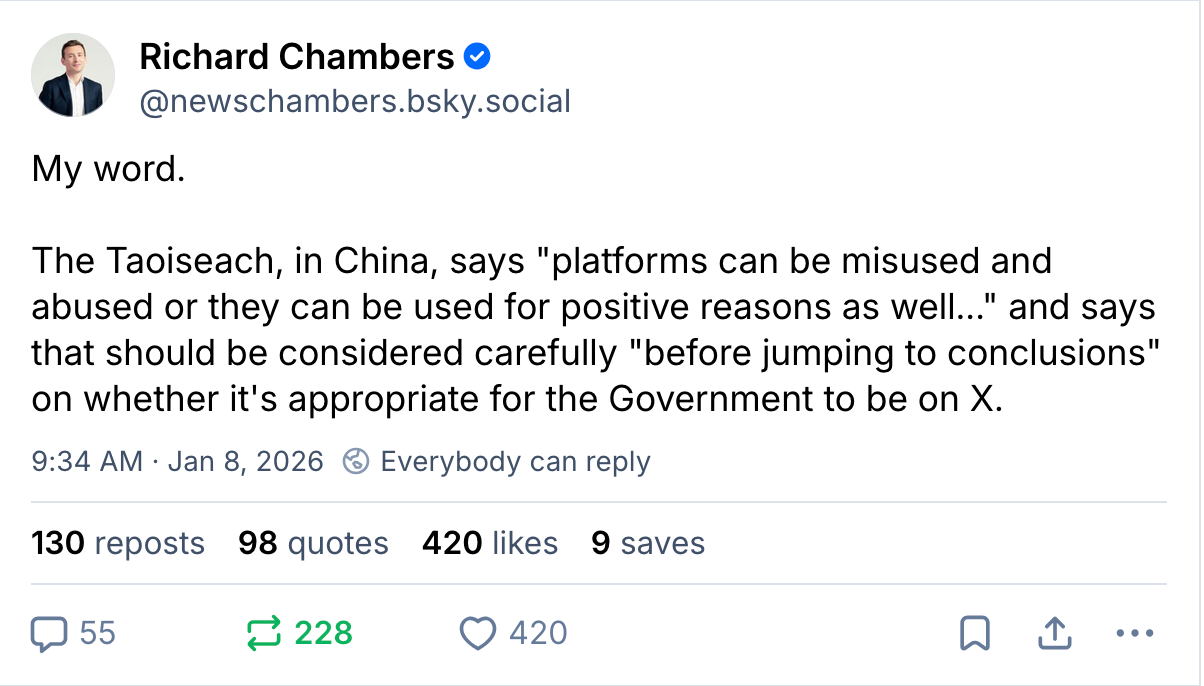
Sure that factory has been making an industrial quantity of child sex abuse images, but the Government also gets some leaflets printed there. So, you know, let's not jump to any conclusions as to whether the Irish State should keep giving it the content which underpins its business.
The Minister for Communications also stepped forward- while, of all places, surrounded by children and teenagers at the Young Scientist's Exhibition- to defend the company who had built a machine for producing child sex abuse material and sexual harassment images.
The fact that he did so in possibly the most asinine, technologically ignorant and morally bankrupt way imaginable, while surrounded by children showing off their love of science and technology was just an extra treat for the rest of us.
@tupp_ed This is a wrong statement of Law, (sections 1,5 and 9 of the Child Trafficking and Pornograp*y Act 1998 make a company facilitating the making of these images criminally liable too) and also a morally bankrupt thing to say.
♬ original sound - Simon McGarr - Simon McGarr
The same Minister had announced before Christmas that he considered child protection online more important even than constitutionally protected Human Rights. But, apparently, both are less important to him than Companies making money.
Digital Rights Ireland and the Irish Council for Civil Liberties sent a joint letter to the Garda Commissioner, seeking an investigation into X Internet Unlimited Company, citing a criminal offence under Sections 5 and 9 of the Child Trafficking and Pornography Act 1998. They eventually received a response simply acknowledging receipt of the letter. We know of no action the police have taken.
Compare that to the 2009 policing and political response to a man making an oil painting of an undressed Brian Cowen holding a toilet roll. Then, just reporting on the story resulted in Today FM getting a garda visit and a threat to obtain a warrant to search their emails to hunt down the artist. “The powers that be want action taken” the police told the producer. RTE memory-holed its own report on the picture and ran a public apology the following day for having accurately told its audience of the event, after receiving a complaint from the then the government press secretary, Eoghan Ó Neachtain.
Clearly, "careful consideration" can happen much faster when the political system objects to the content of an image strongly enough.
None so blind as those who will not see
As part of their efforts to avoid taking any effective action in the face of a glaring mass breach of the law, various political and institutional evasions were attempted. They mostly boiled down to suggesting that Ireland would like to regulate this material, but it had somehow forgotten to make it illegal to deliberately facilitate the production of child sex abuse material.
This suggestion doesn't survive contact with a cursory trip to the Irish statute book.
As DRI and ICCL highlighted in their letter to the Garda Commissioner, the state didn't forget to make CSAM illegal. The Child Trafficking and Pornography Act 1998 is clear and easy to read.
Section 1 defines what it terms as "child pornography" and it specifically deals with images produced by computers. "irrespective of how or through what medium the representation, description or information has been produced, transmitted or conveyed and, without prejudice to the generality of the foregoing, includes any representation, description or information produced by or from computer-graphics or by any other electronic or mechanical means"
Section 5 sets out the offences surrounding the material defined in Section 1;
5.—(1) Subject to sections 6 (2) and 6 (3), any person who—
(a) knowingly produces, distributes, prints or publishes any child pornography,
(b) knowingly imports, exports, sells or shows any child pornography,
(c) knowingly publishes or distributes any advertisement likely to be understood as conveying that the advertiser or any other person produces, distributes, prints, publishes, imports, exports, sells or shows any child pornography,
(d) encourages or knowingly causes or facilitates any activity mentioned in paragraph (a), (b) or (c), or
(e) knowingly possesses any child pornography for the purpose of distributing, publishing, exporting, selling or showing it,
shall be guilty of an offence and shall be liable—
(i) on summary conviction to a fine not exceeding £1,500 or to imprisonment for a term not exceeding 12 months or both, or
(ii) on conviction on indictment to a fine or to imprisonment for a term not exceeding 14 years or both.
(2) In this section “distributes”, in relation to child pornography, includes parting with possession of it to, or exposing or offering it for acquisition by, another person, and the reference to “distributing” in that context shall be construed accordingly.
It is a matter properly left to a Garda investigation to determine how many of the above grounds for prosecution that X Internet Unlimited Company would be captured by. It also matters, as you can see, if they restricted the use of this feature to paid customers as that would raise the question of whether they have been offering the images created for 'acquisition', as referred to in Section 5(2) above.
Finally, in case there were any doubt on the matter, the law also deals with holding officers of corporate bodies which breach Section 5 personally liable.
Section 9 of the Act says:
9.—(1) Where an offence under section 3 , 4 , 5 or 6 is committed by a body corporate and is proved to have been committed with the consent or connivance of, or to be attributable to any neglect on the part of, any person, being a director, manager, secretary or other similar officer of such body or a person who was purporting to act in any such capacity, that person as well as the body corporate shall be guilty of an offence and shall be liable to be proceeded against and punished as if he or she were guilty of the first-mentioned offence.
(The clarity of this corporate liability clause is one of the reasons it is so mysterious that, for example, as late as yesterday the Irish Times published an explainer headed Are sexualised images being made by Grok AI illegal in Ireland? which baldly asserted "In any case, the legal repercussions would fall on those sharing the images, rather than the owner of the technology that created it.")
We can be heroes
In a week of profound institutional failure, it's important to acknowledge two people who didn't avoid their duties to state facts plainly and accurately.
Firstly, Richard Chambers on Virgin Media News stuck with this story day after day, asking questions that forced ministers to address reality. He didn't accept the initial minimising responses and he looked for more than actionless pablum from his interviewees. But most importantly, he held the professional and moral clarity to recognise that a company opening a child sex abuse material factory in the middle of Dublin was a huge story that needed to be covered.
Secondly, plaudits are due to the Minister of State for Trade Promotion, Artificial Intelligence and Digital Transformation, Niamh Smyth. While her senior cabinet colleagues were prevaricating, she said X needed garda investigation into potential criminal acts. While her Senior Minister was arguing against leaving the platform, she deleted her account.
It shouldn't be difficult to act swiftly and without hesitation when the question posed is "Is it OK to work with the child sexual abuse material factory?" But the bar is assuredly in that hole.
Meanwhile, parents can make their own stand. This week, after a parent enquiry, my daughter's primary school announced they were leaving X, removing all of the years and years of images of children's events, sports days and Christmas choirs from X, the deepfake abuse factory.
Perhaps, in the face of the State's political and policing collective shrug, we're all going to have to email our own schools, TDs and businesses and tell them it is time to make their revulsion explicit, and get off X.