The Gist: Britain, the Ungoverned Country
The Labour Party's problem since Keir Starmer was elected was that it fed itself disinformation and pooped disaffection. This is the Gist.

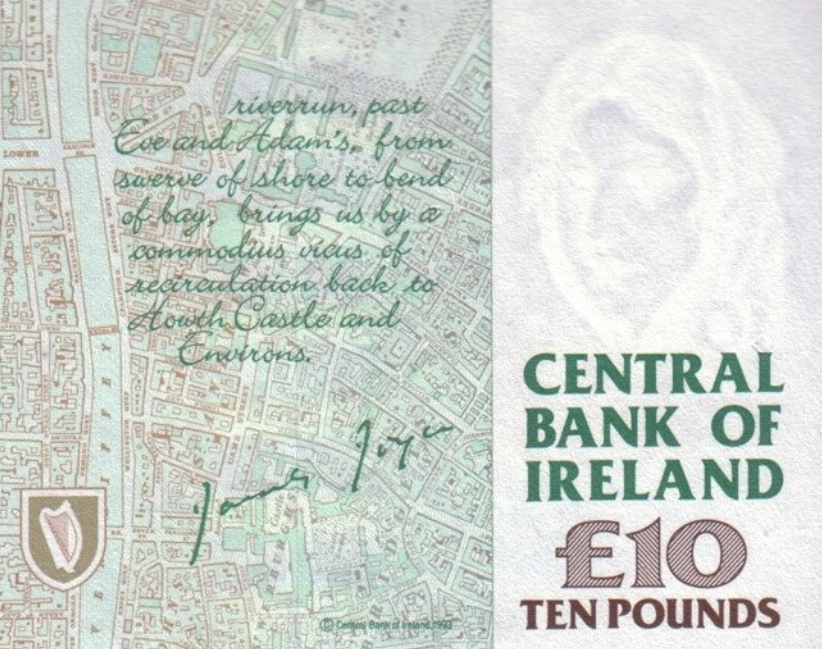
"Riverrun past
Eve and Adams from
swerve of shore to bend
of bay, brings us by a
commodius vicus of recirculation to
Howth Castle and Environs
-James Joyce"
When I was younger, the Irish ten pound note had the opening lines of Finnegan's Wake by James Joyce on the back, overlaid on the Ordinance Survey map of Dublin, beside a watermark ghost of the image of Lady Lavery as Erin, taken from the first independent Irish banknotes. Finally, we declare that this is a product of the Central Bank of Ireland.
This banknote, the work of Robert Ballagh, was a statement from Ireland that also held out a story of Ireland. This was a state with a history (Lavery), with a sense of place (the map) intertwined with a particular story (Finnegan's Wake) of modernity and art, which produces people who can speak to the world (Joyce).
And, because banknotes, in the pre-tap era, were the most widespread works of art in a country, I can still quote those opening lines to this day.
All of which is to say that, despite its many many failures and flaws, the Irish state (and sometimes even members of the government which heads it) has understood the need to tell stories. The story of Ireland was what created an Irish state. It preceded it, and then people were so invested in that story that they fought (and died, and killed) to make it real.
Which, by a commodius vicus of recirculation, takes us to Keir Starmer and Envrions.
Highly Graphic Content
The British Labour Party went into the recent local elections knowing the outcome was going to be very bad. The outcome was then very bad. For some reason, this has caused the party's leader and elected representatives to stagger around in shock.
It seems that losing colonial control of Egypt has not stopped Denial flowing through the British body politic.
We're going to take a look at three charts which will explain how and why the Labour party lost so many seats in the local election. At the end of looking at them, you will be, it seems, better informed than the entire Parliamentary Party of the Labour Party and nearly every mainstream media outlet of the UK. We're delivering some value here today.
Chart 1: Where did the Labour Party Voters Go?
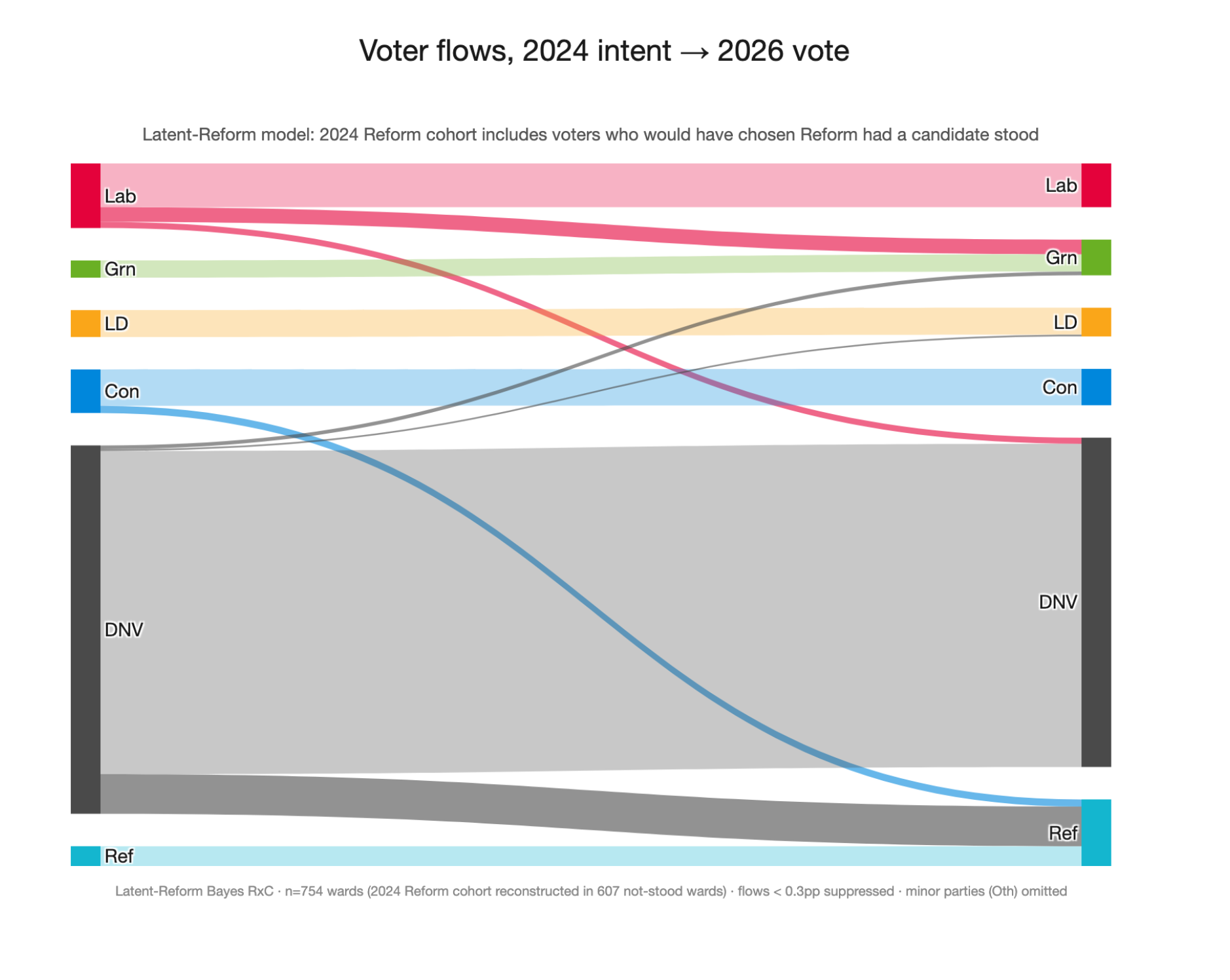
The graph is almost so self-explanatory that additional commentary is superfluous. The Labour Party lost the largest part of its voter base to the Greens. The rest just said they weren't going to vote for anyone. (The big grey block in the middle is the "Did Not Vote" section).
Meanwhile the surge of votes for Reform came mostly from the ranks of people who had not voted in the previous election, as well as a slice of the Conservative party's previous base.
The Greens did manage to activate a slice of those who did not vote as well, but it was a fraction of the bloc of Labour voters it attracted.
To read the very detailed background on the creation of the this graph, please go to the essay by it's creator, Oliver Skånberg-Tippen, setting out how he made it.
Chart 2: Why did the Labour Party voters leave?
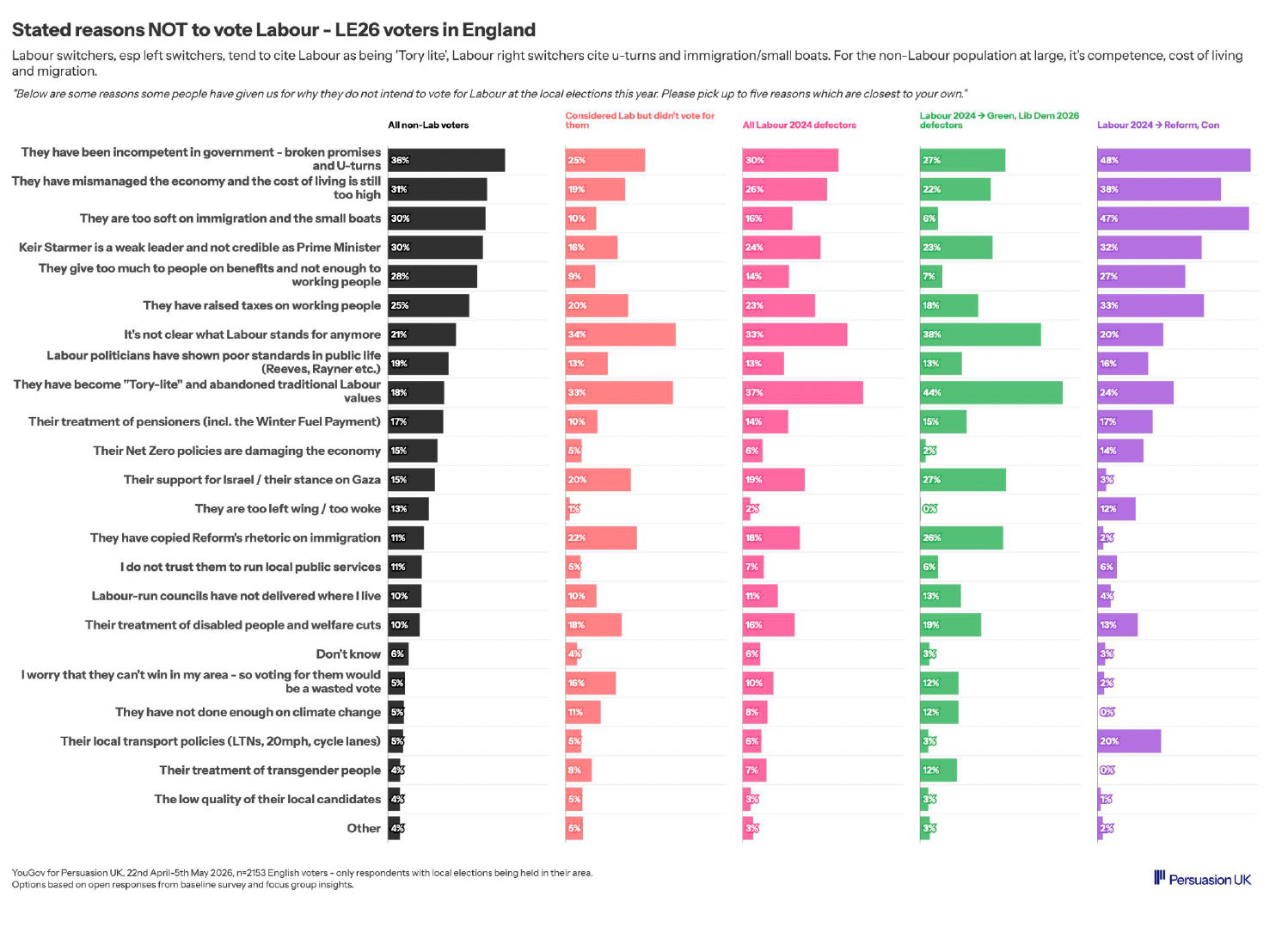
An in-depth report by PersuasionUK, taking England, Wales and Scotland separately, examined why the people who had previously voted for the Labour Party abandoned them. This was the same story from a different angle. Take the pink column in the centre of the chart and we can see that the most common complaints were that "They have become "Tory-lite" and have abandoned traditional Labour values" and "Its not clear what Labour stands for any more".
The complaint with literally the lowest response, the reason that nobody switched their votes from Labour, was "They are too left wing / too woke".
Starmer's Government followed a plan by FG transplant Morgan McSweeney, to tack hard to the right to chase Reform on immigration, bigotry towards trans people and, weirdly, flag-shagging.
This so upset its voters that they got up and left, going to the Green party or just staying at home. It won them precisely zero votes from people who wanted Reform-style policies, who just voted for Reform.
Chart 3: Who are the Labour Party Voters that left?
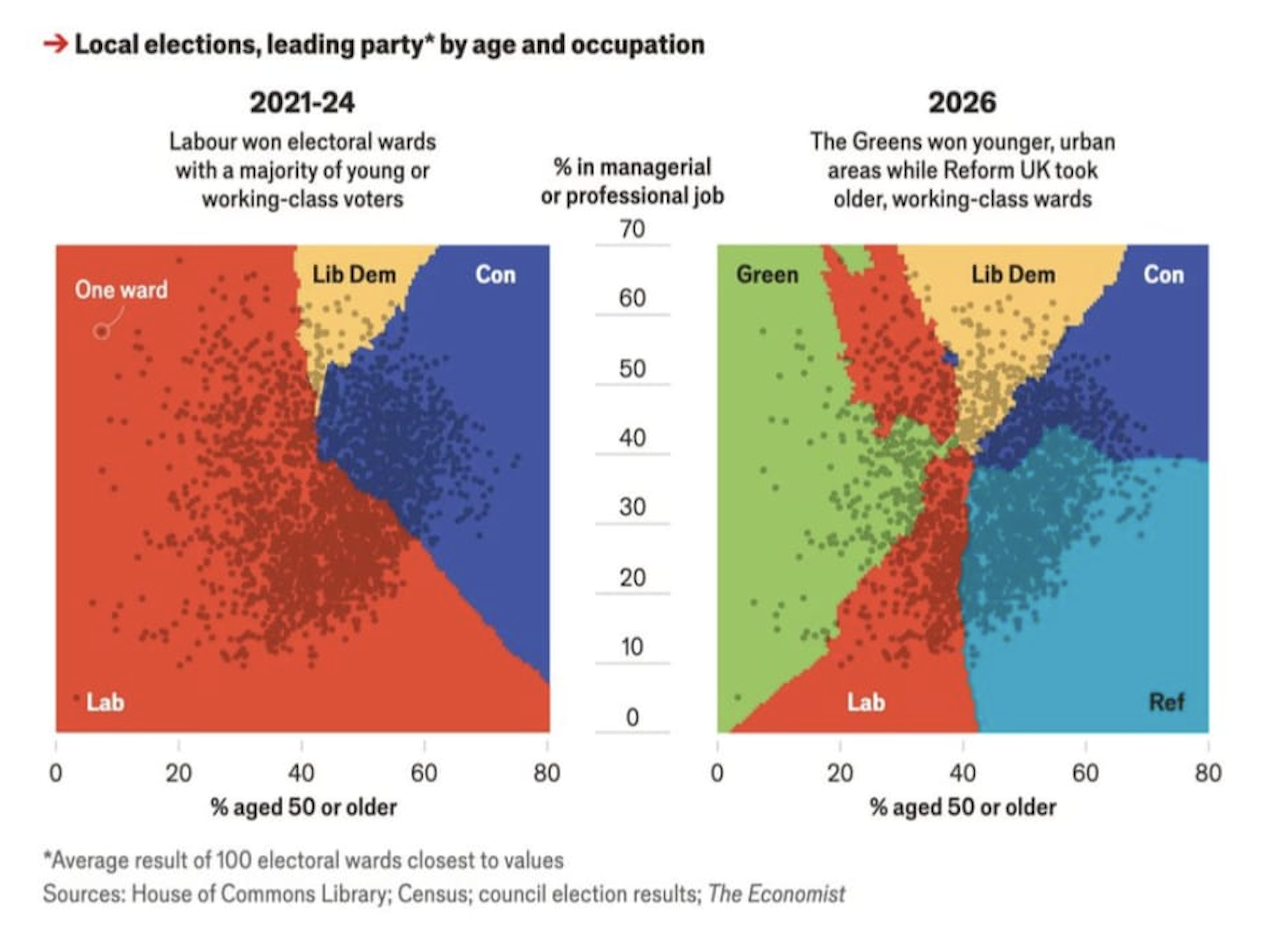
This final chart, from the Economist, is far less straightforward than the first two. On first examination, you'd think that it shows Reform eating about a third of the Labour Party's votes, while the Greens cut in from the left. But actually, that's not what it is showing us.
Because the UK press are infected with almost incurable Two Party System brainworms, they are constantly trying to force their current multiparty reality into the broken two party framings they all grew up with. So this graph shows the destination of the electoral wards (not the votes) by leading party (not by voters).
In other words, where the Reform vote eats a formerly Labour or Conservative ward, it could do that without taking a single vote from either of the other two parties if it got to the top of the list by activating non-voters.
This means that the bottom right of the quadrant (showing older, poorer wards) can't be won back by persuading people to switch back to Labour, because they didn't lose any of those voters there. Instead they've lost because Reform activated non-voters (see Chart 1) and trying to get them to switch onwards to Labour gains you nothing at all but loses you your election. (See Charts 1 and 2).
This matters, because a misunderstanding of the story of Chart 3 has led the Starmer government to destroy itself. It turns out that telling the correct story isn't just a communications job. In politics, making sure your story of your own world around you is grounded in reality is the difference between success and failure.
Countries are all stories in the end
I opened with Finnegan's Wake because it is an example of a government and a state telling its story of a nation. Britain has been telling itself wildly inaccurate stories of itself for decades. The further those stories have drifted from reality, the worse their ability to govern has become. This is not a coincidence. It is cause and effect. Politics tells stories, but they don't create the society that hears them.
A story either resonates, because it talks to people's idea of themselves and their experiences of their lives, or it comes across as false and insincere. Remember Chart 2 above. The second most common complaint from former Labour party voters was "Its not clear what Labour stands for any more". The story Starmer's Labour Party told was inconsistent. (Main complaint from all non-Labour voters: "They have been incompetent in government- broken promises and U-turns")
The Starmer Project was to purge Labour of their left-wing. It ejected the former leader as part of that effort. We now know that was largely a response planned by Peter Mandelson while he also received payments and favours from some of the world's least likeable weirdos.
But it seems that somewhere along the way, the party leadership came to consume their own messaging, like an AI being trained on its own output. They came to genuinely think that their voters (and not just the grim inhabitants and owners of the UK's media) wanted them to mistreat immigrants, trans people, old people and so on. They spent two years in power actually doing those things and indicating they meant to do even more of it. And now they have staggered back from the absolutely obvious consequences of all of those choices in shock and dismay.
At no point since the election has Keir Starmer or any of his supporters said why they think they lost support. To do so is to admit that you have been wrong in understanding the country as a whole, and the Labour Party you lead in particular. And they just won't do it.
This is why none of the existing candidates to replace Starmer are plausible as saviours of the party's fortunes. None acknowledge what has been done, and all of them will carry on doing the same thing and therefore will fail to tell Britain a story of itself that its voters believe.
Famously, the last lines of Finnegan's Wake end mid-sentence and are completed by the first, closing the loop of the book. If the Labour Party want to change, they can't do it by a commodius recirculation.
They either break the loop, or continue to spiral down.